
 English
Views: 51 Author: Site Editor Publish Time: 2025-12-01 Origin: Site
Fermentation is the heart of both beer brewing and kombucha production, but the equipment used for each process is not always identical. Many brewers and beverage startups ask the same question: Can a beer fermenter also be used for kombucha? Or do you need separate tanks to avoid cross-contamination, off-flavors, and quality risks?
As a professional manufacturer of sanitary fermentation systems, DEGONG receives this question frequently from customers in the beer, kombucha, craft beverage, and functional drink industries. This article provides a clear, well-structured explanation of the similarities and differences between beer fermenters and kombucha fermenters—and helps you decide whether a dual-purpose tank is right for your production.
Although beer and kombucha are very different beverages, both require a controlled fermentation environment to ensure:
Stable temperature
Oxygen management
Food-grade sanitary conditions
Effective CO₂ control
Consistent flavor development
Batch-to-batch repeatability
A high-quality fermentation vessel—usually made of food-grade stainless steel (SS304 or SS316L)—is essential for maintaining hygiene and preventing contamination. This is especially important for kombucha, which uses a living culture that contains multiple microorganisms.
DEGONG’s stainless steel fermenters are widely used in breweries, kombucha factories, wineries, and craft beverage production lines because they provide:
Precise cooling temperature control
CIP (Clean-in-Place) systems
Fully weld-polished internal surfaces
Pressure and vacuum resistance
Optional heating or cooling jackets
However, even though the equipment may look similar, beer and kombucha have different fermentation behaviors that influence how the tank should be used.

Understanding the microbiology behind these beverages helps clarify why equipment requirements may differ.
Beer
Beer is typically fermented using a single strain of brewer’s yeast:
Saccharomyces cerevisiae (ale yeast)
Saccharomyces pastorianus (lager yeast)
This is a controlled, predictable fermentation with strict hygiene requirements.
Kombucha
Kombucha is fermented using SCOBY — a Symbiotic Culture of Bacteria and Yeast, typically containing:
Acetic acid bacteria
Wild yeast
Lactic acid bacteria
Cellulose-producing microorganisms
This is a complex, mixed-culture ecosystem that grows rapidly and adheres strongly to tank surfaces and sealing components.
| Parameter | Beer | Kombucha |
|---|---|---|
| Temperature | 10–22°C depending on style | 22–30°C |
| Microbial Risk | Sensitive to contamination | SCOBY is strong & persistent |
| pH | 4.0–5.0 | 2.8–3.5 (more acidic) |
| Oxygen | Prefer low-oxygen / anaerobic | Requires early oxygen exposure |
| Alcohol | 4–8% | <0.5–2% (low alcohol) |
Because kombucha is acidic and contains powerful bacterial cultures, it can create long-term residual biofilms inside a fermenter if not cleaned properly.

Technically yes—but practically, it carries risks. Below is a detailed evaluation based on DEGONG’s engineering and customer experience.
A stainless-steel fermenter can be used for both beer and kombucha if:
The tank is fully welded with no dead angles
All fittings are tri-clamp sanitary connections
CIP cleaning can reach every surface
All gaskets, valves, and ports can be removed and sterilized
The tank can handle acidic conditions
DEGONG offers acid-resistant stainless steel fermenters that can withstand kombucha’s low pH environment, making dual-use technically feasible.
Even after chemical sanitizing, kombucha bacteria and wild yeast can hide inside:
Gaskets
Valves
Butterfly seals
Thermowell gaps
Sampling ports
Manway seals
Scratches or micro-pits in the steel
These microorganisms can survive and infect future beer batches, causing:
Over-attenuation
Acetic acid aroma
Excessive sourness
Cloudiness
Exploding bottles
“Wild fermentation” off-flavors
Many professional brewers consider SCOBY contamination nearly impossible to fully eliminate without complete sterilization, not just sanitizing.
For a craft brewery producing premium beer, this risk is usually unacceptable.
Even microscopic residues of kombucha bacteria can dramatically alter beer. Typical problems include:
Vinegar aroma from acetic acid bacteria
Excessive souring
Uncontrolled carbonation
Pellicle formation in the fermenter
To avoid these issues, most breweries never use beer tanks for kombucha, even with thorough cleaning.
Switching from beer to kombucha is less risky, but:
Beer yeast may alter SCOBY performance
Hop residues may inhibit bacteria
Beer aroma may mix into early kombucha batches
Thus, while workable, it still requires careful cleaning and steaming before switching.
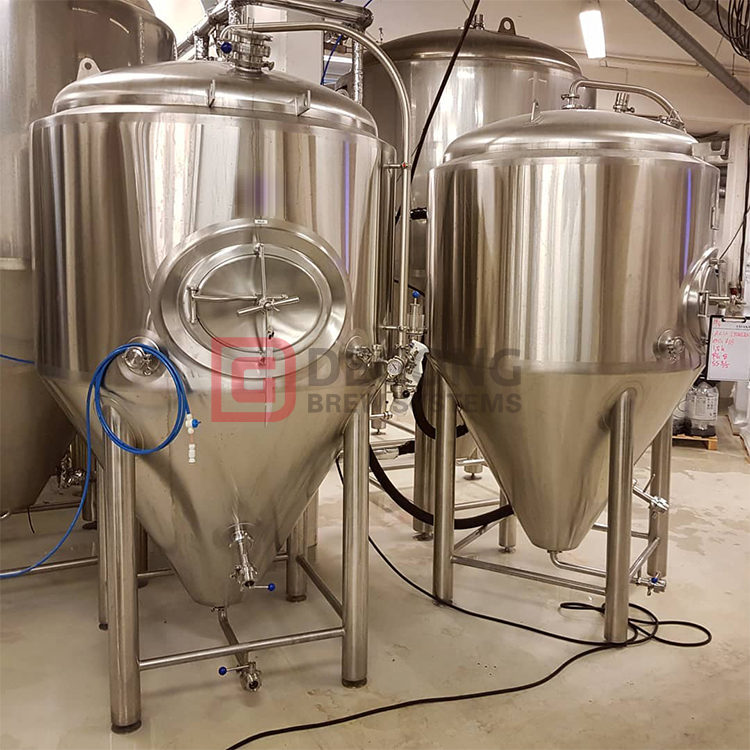
If you are producing both beer and kombucha at a commercial scale, DEGONG strongly recommends:
Dedicated fermenters for beer
Dedicated fermenters for kombucha
This ensures optimal hygiene, predictable flavor, and stable long-term production.
If you must use one tank for both beverages, DEGONG recommends the following procedure:
(1)Deep CIP cleaning
High-alkaline detergent
Followed by acid rinse
Followed by hot water (≥ 80°C)
(2)Full disassembling of all valves and fittings
(3)Steam sterilization (preferred)
100–121°C if the tank is steam-rated
(4)Replace all gaskets
Cheap and effective way to prevent contamination
(5)Inspect surface roughness
Internal tank finish should be Ra ≤ 0.4 μm
Only after these steps can a beer tank be safely used for kombucha or vice versa.

Although kombucha tanks look similar to beer fermenters, they often include special features:
(1)Oxygen-Friendly Design
Kombucha requires oxygen in the first stage, so the tank may use:
Wide manway opening
Dedicated ventilation port
Optional breathable cover
Non-pressurized design
Beer fermentation, in contrast, is strictly anaerobic.
(2)Open-Fermentation Option
Some kombucha producers prefer shallow, open tanks to encourage SCOBY growth. DEGONG offers both traditional closed tanks and open-top stainless steel fermenters for kombucha factories.
(3)Materials for High Acidity
Because kombucha pH can be as low as 2.8, long-term use requires:
High-grade stainless steel
Acid-resistant valves
Proper internal polish
This prevents corrosion and maintains food safety.
(4)Higher Temperature Range
Kombucha ferments at warmer temperatures than beer.
DEGONG kombucha tanks include:
Larger cooling jackets
Optional heating function
Wider temperature control range

Here is a simple evaluation to help you choose.
Choose a Shared Fermenter If:
You are testing the market
Your batch size is small
Beer is not your primary product
Some flavor variation is acceptable
Choose Separate Fermenters If:
You run a commercial brewery
Consistent flavor is essential
You produce both beverages regularly
You want to avoid contamination risk
You require strong quality control
You value long-term operational stability