
 English
Views: 38 Author: Site Editor Publish Time: 2025-11-18 Origin: Site
Building a large-scale brewery requires a clear plan, reliable equipment, and a strong understanding of sanitary design, layout, utilities, and automation. DEGONG has supported hundreds of brewery projects worldwide, and this guide summarizes the key principles to help you build a high-performance, expandable, and compliant production facility.
Every successful brewery starts with a balanced production plan.
Begin with the brewhouse size, then calculate the required number of fermenters, brite beer tanks, and cooling capacity. A common rule is to size the cellar at 4–6 times the brewhouse volume to maintain a steady brewing cycle. A practical formula often used:
Annual output = brewhouse size × batches/day × brewing days per year
Early planning should also include:
Steam, electricity, water supply, glycol chiller load
Drainage slope, trench positions
Expansion zones for future tanks
DEGONG recommends reserving at least 20–30% spare space for expansion, to avoid expensive reconstruction later.
A professional layout clearly separates workflow zones:
Raw materials → Brewing area → Fermentation area → Packaging line → Utilities zone
Good layout design improves hygiene, reduces contamination risk, and simplifies daily operations. Key considerations for DEGONG brewery projects include:
Anti-slip flooring and correct slope toward drains
Proper spacing between tanks for access and CIP
Forklift lanes and safe pedestrian pathways
QA laboratory and chemical storage areas
Adequate ventilation and exhaust in hot areas
A clean, organized layout directly contributes to long-term efficiency and product consistency.
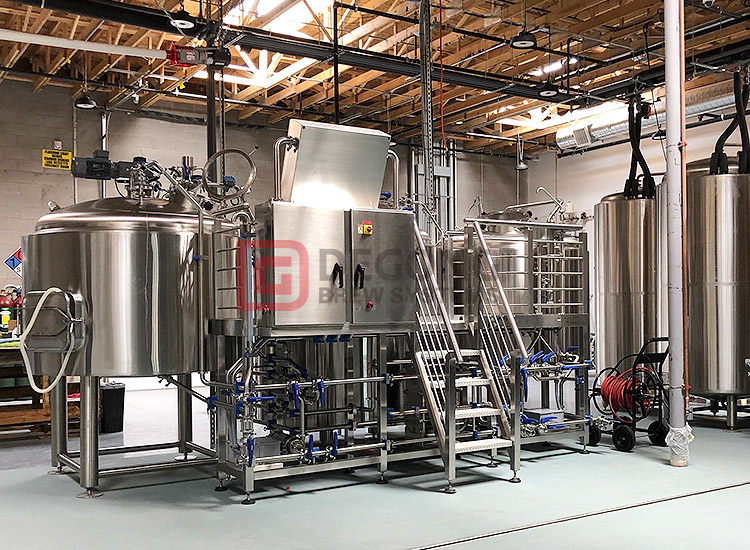
The brewhouse is the heart of the brewery. DEGONG offers 2-vessel, 3-vessel, 4-vessel, and fully automated systems depending on your required productivity and recipe diversity. Core features of a modern brewhouse include:
High-efficiency mash mixing system
Optimized lautering plates for fast run-off
Stable steam jackets for strong boiling intensity
Low-oxygen design for improved wort quality
Precise flowmeters, pumps, valves, and temperature control
Platforms designed for operator comfort and efficiency
A 4-vessel configuration significantly increases throughput and consistency for mid- to large-scale breweries.
Automation ensures product stability, safety, and repeatability. DEGONG’s control platforms can integrate:
Brewhouse automation
Fermentation temperature control
CIP sequences
Packaging line synchronization
Data logging and batch reports
With interlocks, alarms, and recipe management, operators follow a clear workflow—reducing human error and improving product uniformity.

Hygiene is the foundation of quality. DEGONG designs all pipelines with proper slope, minimal dead zones, and sanitary welding. Essential elements include:
Hygienic valves and automated actuators
Spray balls for tanks
CIP supply & return loops
Sight glasses and sample ports
Verified weld quality (inside & outside)
A well-designed CIP system allows safe, reliable cleaning without disassembling tanks or pipes, saving labor and minimizing contamination risk.
The cold side defines beer flavor stability. DEGONG designs complete glycol systems that include:
Correct pipe sizing and insulation
Balanced loops across all tanks
Backup circulation pumps
Accurate glycol temperature control
Utilities such as steam, compressed air, water treatment, and power distribution must be engineered early and recorded in detailed drawings for future expansions.

Packaging is the final critical stage before the beer reaches consumers. DEGONG provides turnkey filling and packaging solutions for:
Cans
Bottles
Kegs
Important design considerations:
Linear product flow
Buffer zones between machines
Clean, segregated packaging environment
Adequate space for palletizing and storage
A well-engineered packaging area ensures high throughput and protects beer quality.
Although brewing principles are the same, scale brings additional complexity:
Larger vessels
Higher steam and cooling demand
Longer piping distances
Strict ventilation and wastewater regulations
More complex utilities and automation
But at any scale, DEGONG follows the same principles:
Cleanability, accessibility, process efficiency, and long-term expandability.

For renovation projects, DEGONG first evaluates:
Floor loading capacity
Power supply capability
Drainage system and trench location
Ventilation and exhaust
Space for tanks and piping routes
Drainage is often the most challenging part—insufficient slopes or poorly placed trenches can cause operational issues for years.
DEGONG installation usually follows a phased approach:
Equipment delivery and inspection
Tank placement and anchoring
Utility connection (steam, glycol, water, electricity)
Piping installation
Commissioning tests (water test → wort test → full production)
We recommend performing water brewing trials first to verify pumps, valves, automation, and CIP sequences before moving to real production.
A strong system needs a strong team. DEGONG provides on-site or remote training for:
Brewhouse operation
Fermentation management
CIP cleaning
Preventive maintenance
Quality control basics
We also supply recommended spare parts lists to ensure smooth operation.
