
 English
Views: 18 Author: Site Editor Publish Time: 2025-08-01 Origin: Site
Adding hops to the fermenter bypasses the boiling and fermentation process, preventing the volatile oils that give beer its wonderful hop aroma from evaporating during fermentation due to heat or being removed through off-gassing. There are many ways to use hops to add bitterness, flavor, and aroma. Brewers use hop racks to maximize the aroma of hops and capture volatile compounds in hops that might be removed when they are added earlier in the brewing process.

Hopping involves adding hops after the boil and allowing them to steep in the wort for a period of time as the wort begins to cool. Hops are typically added during the swirl period. Hop racks are sometimes called "swirl hops."
The goal is to capture the more subtle aromas of the hop varieties used, rather than letting them fade away over time in the boiling wort. Adding sufficient hops to the rack is crucial for brewing a beer with a rich, hoppy flavor, allowing the hop aroma to be more prominent and prominent.
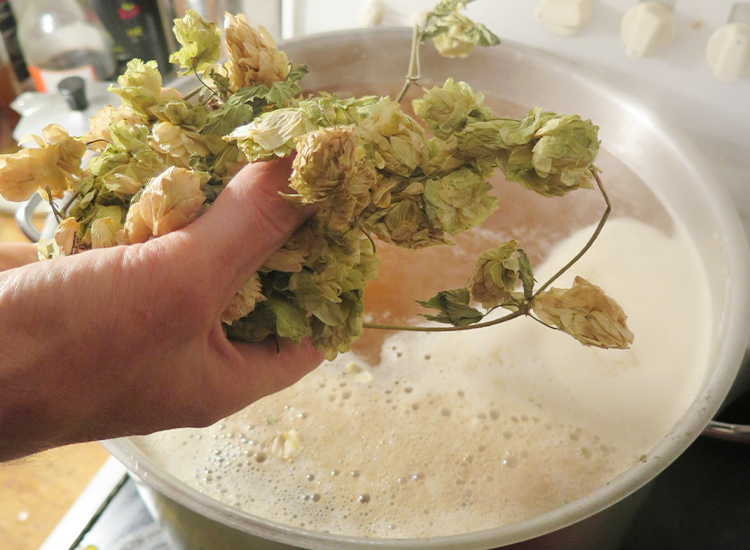
The best feature of swirl hopping is adding hops and dry hopping immediately before the boil. This is because the hot wort (below boiling temperature) releases essential oils that are not released at dry hopping temperatures, while also minimizing the evaporation of these oils at boiling temperatures. Because alpha acids isomerize at temperatures above 79°C (175°F), this process can impart some bitterness to beer. This isomerization rate is slower than at boils of 100°C (212°F) or higher, and is generally considered to produce a smoother bitterness than an early boil.
Discussions regarding hop oils often focus on the following components: total oil, beta-pinene, myrcene, linalool, caryophyllene, farnesene, humulene, and geraniol. The primary hydrocarbons in hop oils are terpenes (such as myrcene, humulene, and caryophyllene), which are considered one of the primary contributors to the hop aroma in beer.

A simple way to make aroma extracts is to boil a small amount of wort, remove it from the heat, and steep some hops in it. Once the hop oil extract has cooled, it can be added to the beer. The wort sugars added to the beer will be consumed by the yeast. If you're adding aroma extracts while preparing your beer for bottle or keg aging, boil equal parts malt extract and base sugar, and use double the amount of hop oil extract as the base.
This method doesn't cause any loss of beer compared to dry hopping. The beer's volume will increase slightly. If you plan to add hops early, you should take this into account to compensate for any dilution. Furthermore, this method doesn't cause the beer to become hazy compared to dry hopping.

To achieve the same aroma intensity, you'll need fewer hops than you would with rotation hopping. Typically, you'll use slightly less hops than you would with dry hopping. (Keep in mind that dry hopping has different characteristics, so you can combine this technique with dry hopping if you prefer.)
Some might think there's little difference between a hop stand and adding a large amount of hops after the boil. They're similar in that both methods produce a rich hop aroma.
The hop tank setup is more nuanced. Consider the wort temperature before adding hops. Lowering the wort from a boil to around 75-80°C before adding hops not only affects the aroma but also the bitterness extracted from the hops.
At a lower temperature, the amount of hops used is lower, meaning Tesco has fewer alpha acids. At a lower temperature, you can extract more aroma and less bitterness from the hops.
