
 English
Views: 28 Author: Site Editor Publish Time: 2025-12-26 Origin: Site
The fermentation tank is the core vessel of the beer-brewing process. It provides the controlled environment in which yeast converts wort into beer, forming alcohol, carbonation, and characteristic flavor profiles. However, a stable and efficient fermentation process depends not only on the tank itself, but also on a complete set of auxiliary equipment that supports temperature regulation, pressure stability, sanitation, and brewing consistency.
As a professional brewing-equipment manufacturer, DEGONG integrates these auxiliary components into its fermentation systems to help breweries achieve precise control, reliable performance, and long-term production stability.
Temperature control is one of the most critical factors in fermentation, influencing yeast activity, flavor development, and final product quality.
Common auxiliary components include:
Cooling jackets and glycol circulation systems
Used to stabilize fermentation temperature during active yeast activity.
Temperature sensors and digital controllers
Enable accurate monitoring and programmable control for different beer styles.
With precise temperature stability, brewers can maintain consistency across every batch.

During fermentation, carbon dioxide is continuously produced and must be safely managed.
Typical accessories include:
Pressure relief valves and regulators
Prevent over-pressurization while allowing controlled CO₂ retention.
Airlocks or gas-exhaust devices
Allow gas to escape while keeping external contaminants out of the tank.
These components enhance both operational safety and product stability.
Reliable data feedback helps brewers control the entire fermentation process more accurately.
Auxiliary devices may include:
Pressure gauges and manometers
Liquid-level indicators
Sampling valves for quality testing
These tools enable sanitary sampling and scientific brewing management.

Stable and hygienic liquid- and gas-flow systems are essential to fermentation efficiency.
Typical accessories include:
Manual or automated process valves
Sanitary pipe fittings and quick-connect couplings
Welded or clamp-type tank connections
High-quality fittings reduce leakage risk and simplify maintenance.
Sanitation control is a decisive factor in beer quality.
Key auxiliary components include:
CIP (Clean-in-Place) spray balls
Sanitary seals and gaskets
Hygienic-grade cleaning interfaces
A well-designed CIP-ready tank helps minimize contamination risk and improves overall hygiene management.

According to production needs, breweries may also apply:
Carbonation stones for controlled CO₂ infusion
Insulation layers for better thermal stability
Adjustable support legs or structural reinforcement
Semi-automatic or fully automated monitoring modules
These optional upgrades further improve process precision and production flexibility.
A fermentation tank alone cannot guarantee stable brewing results. It is the auxiliary equipment that:
enables precise process control
safeguards operational safety
improves sanitation reliability
enhances production repeatability
DEGONG integrates these auxiliary systems into its fermentation solutions, delivering complete, hygienic, and scalable brewing-equipment platforms for craft and commercial breweries alike.
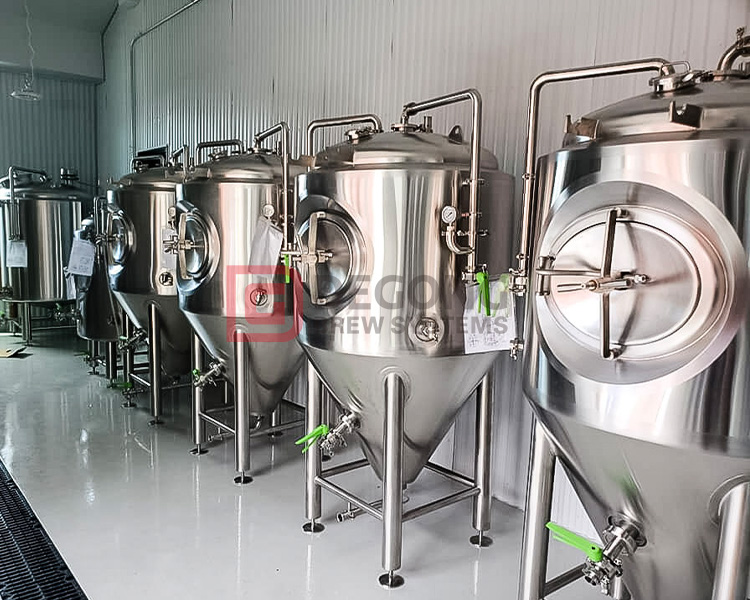
A modern beer fermentation system is not merely a single vessel — it is a coordinated combination of auxiliary equipment working together to create quality beer. Temperature control, pressure management, pipes and valves, monitoring accessories, cleaning systems, and optional enhancements all play critical roles in ensuring brewing efficiency and product consistency.
With its engineering expertise and application experience, DEGONG provides integrated fermentation-system solutions, helping breweries achieve professional-grade production control and long-term operational reliability.
